












LETTER TO THE SHAREHOLDERS
May 04, 2026
Napoleonville, LA IFUS:OTCID
In our continued quest to provide to the global community eco-friendly, costeffective, and sustainable products supported by scientifically based technologies, Impact Fusion International has increased both capacity and efficiency to produce an All-Natural Oil Remediation and Clean-Up Product Line: SupremeOR™.
For over a decade, IFUS has been using its SupremeOR™ in the Napoleonville, LA facility to clean-up hydraulic oil spilled from operating machinery. What IFUS has observed is as follows:
- Not only is 100% of the oil quickly absorbed by SupremeOR™, but preexisting dirt from the concrete is lifted off the surface leaving a white-patch of sorts of cleaned concrete.
- The SupremeOR™ with oil absorbed is then placed in a remediation container, only to find the product transformed into dirt with NO oil smell or feel.
Furthermore, industrial entities have successfully applied SupremeOR™ in their respective operations.
Hence, science poses the question: Does Sugarcane Bagasse Absorb Oil? The
IFUS Scientific Team finds plausible evidence to support the efficacy of SupremeOR™ as an oil remediation product as shown by SEM (Scanning ElectroMircographs) below:
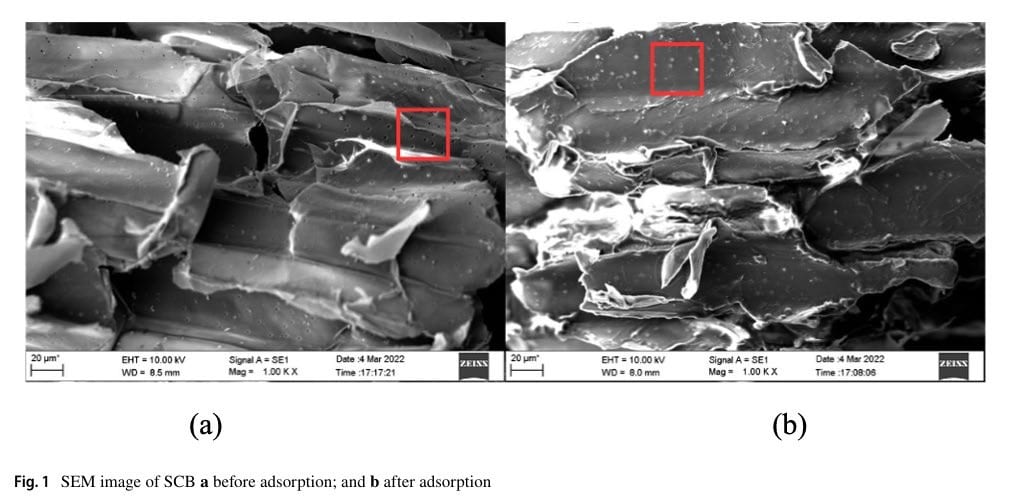
Source: Avryl Anna Machado, et.al, “Adsorption of oil from water using sugarcane bagasse: an analysis using response surface methodology,” Monatshefte für
Chemie – Chemical Monthly (2025) 156:617–630, Received: 17 November 2024 /
Accepted: 10 March 2025 / Published online: 26 March 2025 https://doi.org/10.1007/s00706-025-03311-x\
Dr. Machado and team state, “Abstract: Oil and grease are common industrial pollutants, but most treatments for oil pollution are expensive, heavy in carbon footprint, and inaccessible to most. This study investigates the potential of sugarcane bagasse (SCB) as a cost-effective adsorbent for mitigating oil pollution in oil-in-water emulsions. Focusing on sunflower oil, a prominent constituent in kitchen waste water, this research explores SCB’s efficacy in oil removal. With readily available materials and chemicals, the proposed method holds promise for replication in small-scale industries. Employing Box–Behnken and response surface methodology, the experiments performed were between temperatures of 30–60 ℃, agitation speeds of 150–210 rpm, with contact times between 5 and 60 min, adsorbent dosages of 0.006–0.036 g, and initial oil concentrations of 0.2–1%. The optimal operational parameters were identified, resulting in a noteworthy oil removal efficiency of 74.415% under specified conditions of 59.9℃, 9 min, 180 rpm, 0.012 g of SCB, and 0.2% initial oil concentration, underscoring the effectiveness of the adsorbent at minimal cost inputs. Further, characterization techniques such as scanning electron microscopy and Fourier-transform infra red spectroscopy were employed to highlight the structural and functional features that enable optimal adsorption. Future research can explore various types of oil and contribute to advancing a circular economy.”
Furthermore, Sugarcane Bagasse is shown to mediate Heavy Metals:
In research conducted by A.O. Adeyemi, et.al., he and his team published and
presented the following paper: “ECO-FRIENDLY SOLUTION FOR HEAVY
METALS POLLUTION: SUGARCANE BAGASSE ACTIVATED
CARBON IN GOLD MINING WASTEWATER,” International Conference on
Science, Engineering & Environmental Technology (ICONSEET), 16(16): 70-78,
2024. ISSN 0794-9650
“Abstract–Liquid waste discharge from process industries, when not properly handled and disposed, poses a great risk to both man and the environment. Sugar cane bagasse was chosen as an activated carbon for this study. Two sugarcane bagasse-based adsorbents were prepared and used in batch experiments, Sugarcane Bagasse Ash (SBA) was obtained by subjecting to calcination in a furnace at 600℃ while Activated Sugarcane Bagasse (ACTSB) was prepared by soaking calcinated sugarcane bagasse in 1M HCl for 24 hours. The focus of this study is the use of low-cost and efficient agro-waste material for removing Cadmium (Cd2+), Iron (Fe2+), Lead (Pb2+), and Zinc (Zn2+) ions from Gold Mining
Wastewater (GMW). The produced samples were characterized using Fourier
Transform Infrared Spectroscopy (FTIR) for functional components (ligands) and
X-ray Diffraction (XRD) for mineral constituent. Atomic Absorption Spectrometer (AAS) was used to determine the initial concentration of heavy metals. The effect of the absorbent dosage at constant temperature of 27℃, contact time of 20 mins, and agitation speed of 50 rpm to determine the removal efficiency were calculated. FTIR for SBA ranged from 695.1 to 2290.4 while ACTSB was at 777.1 to 2974.3. XRD quarty mineral content of SBA was high compare to ACTSB with a higher
Magnesite content. SBA was the best in removal of Cd2+ and Zn2+. While
ACTSB was best in removing Fe2+, and Pb2+ ions both at 0.6g dosage.”
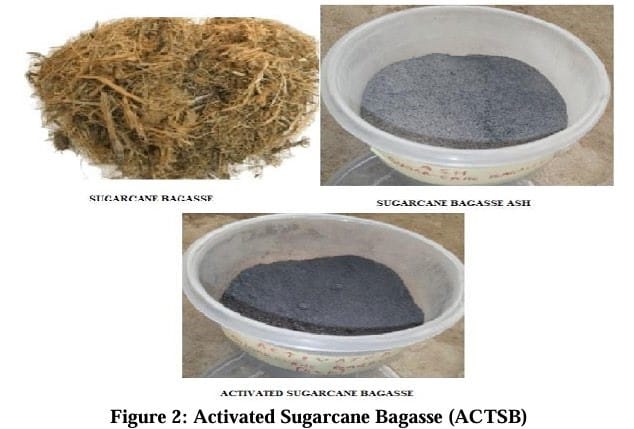
Where SupremeOR™ looks differently from the pictures above, this is a result of what IFUS holds to be a more cost-effective, eco-friendly, and sustainable proprietary processing method (discovered, and not invented). However, science performed by the aforementioned team of scientists provides invaluable insight into creating plausible explanations as to why SupremeOR™ works.
Further evidence is found in a paper published by V. Vetriselvi and J. Devakumar,
“SUGARCANE BAGASSE AS A NATURAL ADSORBENT FOR THE
REMOVAL OF SELECTIVE HEAVY METAL IONS – A COMPARATIVE
STUDY,” International Journal of Research and Analytical Reviews (IJRAR), August 2023, Volume 10, Issue 3, www.ijrar.org (E-ISSN 2348-1269, P- ISSN 2349-5138).
“ABSTRACT: The effluents from the industrial wastes reach the environment without any treatment making series (sic) problem. The heavy metals present in the contaminated water and are accumulated in living organisms and produce diseases and disorders. This work introduces the feasibility of using sugarcane bagasse (SCB) as a selective adsorbent for the adsorption of heavy metals; chromium, copper, cadmium, mercury and lead. The sugarcane bagasse was characterized by FT-IR and SEM. The initial and concentrations of the metal ions were obtained by ICP-OES studies. The adsorption studies were carried out only for copper and chromium using dynamic method with the different parameters namely; effect of contact time, effect of adsorbent dosage and influence of pH. The adsorption isotherm studies were carried out using Langmuir and Freundlich isotherm models. The parameters of Langmuir and Freundlich isotherm were calculated. The Langmuir isotherm of Cu(II) has adsorption capacity(Qo) of 7.49×10⁻³ mmolg-1 exhibit monolayer adsorption. The Cr(VI) exhibit Freundlich isotherm multi layer adsorption with adsorption capacity (KF) of 7.16 x10⁻³ mmolg-1. After optimization the adsorbent dosage, contact time and pH the other metals cadmium, mercury and lead were allowed to adsorb on the sugarcane bagasse similar to that of copper and chromium. The FT-IR, SEM-EDS and ICP-OES studies before and after treatment with the bioadsorbent were examined. At the pH of 1 the extent of adsorption follows the order Hg(II) 97% > Cr(VI) 96% > Cu(II)93% >
Pb(II)91% > Cd(II) 83% . The presence of chromium, lead, mercury cadmium and copper peaks in the EDS further confirms the adsorption of metal ions leading to maximum adsorption efficiency. Thus the sugarcane bagasse has pronounced capability for uptake of heavy metal ions.” (See Figure 3 below)
In reviewing SEM’s of Sugarcane Bagasse (SB) as compared to activated charcoal and other similar materials, the IFUS Scientific Team believes that further research is warranted into the potential efficacy of SB borne from the possibility of SB possessing clathrate-like capability. A clathrate compound is defined as “a compound in which molecules of one component are physically trapped within the crystal structure of another.” Hence, if this proved true, then substances like heavy metals could be rendered inert.
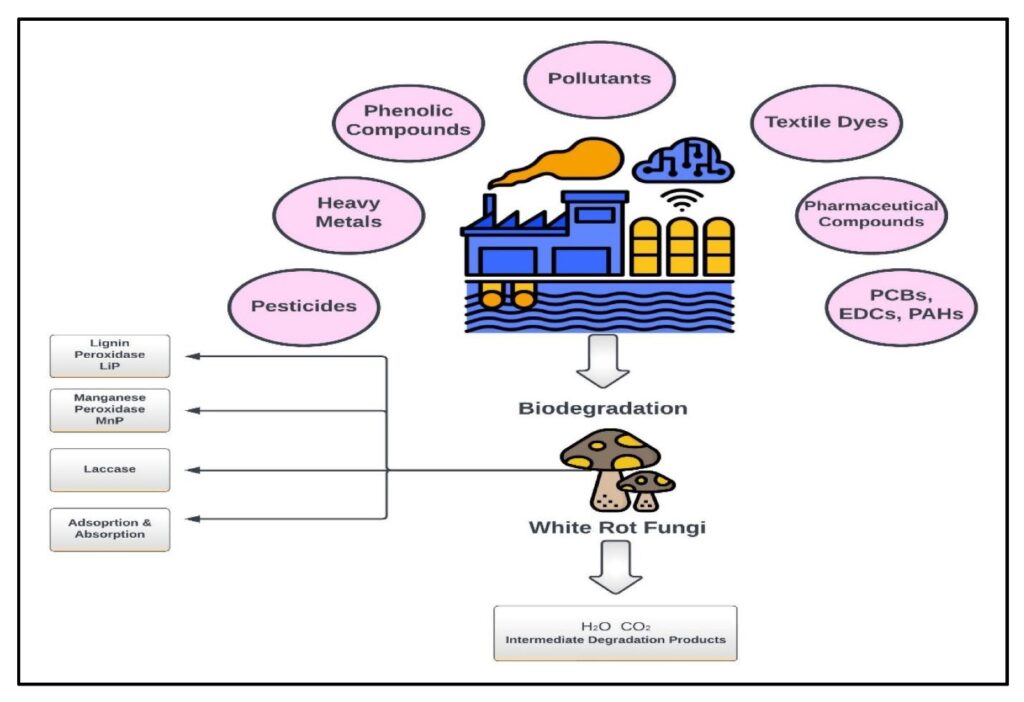
Lastly, it has been well-established that Sugarcane Bagasse contains an incredibly complex microbial biome to include White Rot Fungi. Science offers to us studies published by teams like that of S. Singh, et.al., “A comprehensive review on whiterot fungi for their pivotal role in degradation of pollutants.” Discover Water Volume 6, Article 28 (2026). https://doi.org/10.1007/s43832-026-00343-0
“Abstract: Considering the vast ability of White-rot fungi (WRF) enzymes to degrade a wide range of resistant contaminants and polymers, much interest has been evinced in the use of WRF and their enzymes in several environmental matrices. Bioremediation using microorganisms or their enzymes offers a promising approach to treating environmental pollutants by breaking them down or converting them into less harmful or non-toxic forms. This biological process effectively reduces the toxicity and environmental impact of various contaminants. This paper investigates the mechanisms underlying WRF’s ability to break down diversity of contaminants with focusing on the roles of their enzymatic resources. In contrast to traditional methods of pollution control, which often involve costly, chemical-intensive processes that can generate secondary pollutants, WRF offers a sustainable and economical alternative. They have the unique ability to degrade the various organic compounds; hence they are considered as nature’s best cleaners for breaking down stubborn organic matter. This review contains studies published from 1995 to 2025, providing a comprehensive overview of the enzymatic mechanisms, pollutant degradation pathways, and emerging applications of WRF in bioremediation like wastewater treatment, dye degradation organic pollutant degradation, plastic degradation and lignocellulosic biomass degradation with lignocellulolytic enzyme production is explored. The oxidative breakdown of chemical bonds by WRF not only depolymerizes complex pollutants but also contributes to their complete mineralization, presenting a promising approach for environmental cleanup, with that this article presents new opportunities for addressing environmental pollutants and then waste management by mycoremediation.”
Source: https://pub.mdpi-res.com/applsci/applsci-13-

08318/article_deploy/html/images/applsci-13-08318-g003.png?1689764695
The processing of Sugarcane Bagasse into SupremeOR™ through IFUS’ proprietary formulation method is shown to preserve White Rot Fungi and other components of the natural microbial biome of SB.
Our IFUS Scientific Team is presently completing a White Paper where the science offered above is expanded with additional data. As soon an updated version is complete, it will be posted on the IFUS Website and we will update you.
“With the recent purchase of the Selco/Mosley Badger Double Ram Press (delivery and installation now planned for the 1st Week of June 2026), we have improved our corporate Footprint by increasing the efficiency and throughput of both SGP+™ and SupremeAG™. The existing machine on-site is being retrofitted to produced SupremeOR™ (SOR™). Customer orders for all three of the bagassebased products can be placed on the IFUS Website, as well as samples of the product. With the addition of SupremeOR™, your company expands its commitment to produce products supported by technology that are eco-friendly, cost-effective, and sustainable. Our goal remains ever-more important, that being to IMPACT our stakeholders in a positive manner…for soil, plant, animal, and human health. This remains our most fundamental outcome. And, we believe that this investment into updated technology and an enhanced production design that now includes SupremeOR™ will benefit you, our stockholders, as we consider solutions that provide safe and healthy outcomes to the global population,” said Marc Walther, CEO of Impact Fusion International.
Once more, we are “Back to work!”
The information provided is for informational purposes only and is not intended as medical advice. Our products are not intended to diagnose, treat, cure, or prevent any medical condition. Always consult with a qualified healthcare professional before starting any new supplement, diet, or health regimen.
For our customers of both Intact Digest™, Intact Endurance™ and Pet Intact™ you may now send your testimonials to:
mwalther@impactfusionintl.com We can also be reached at 1-800-775-4130 seven days a week.
You must be logged in to post a comment.